Health · Crying
Why is my baby fussy every evening?
Short answer
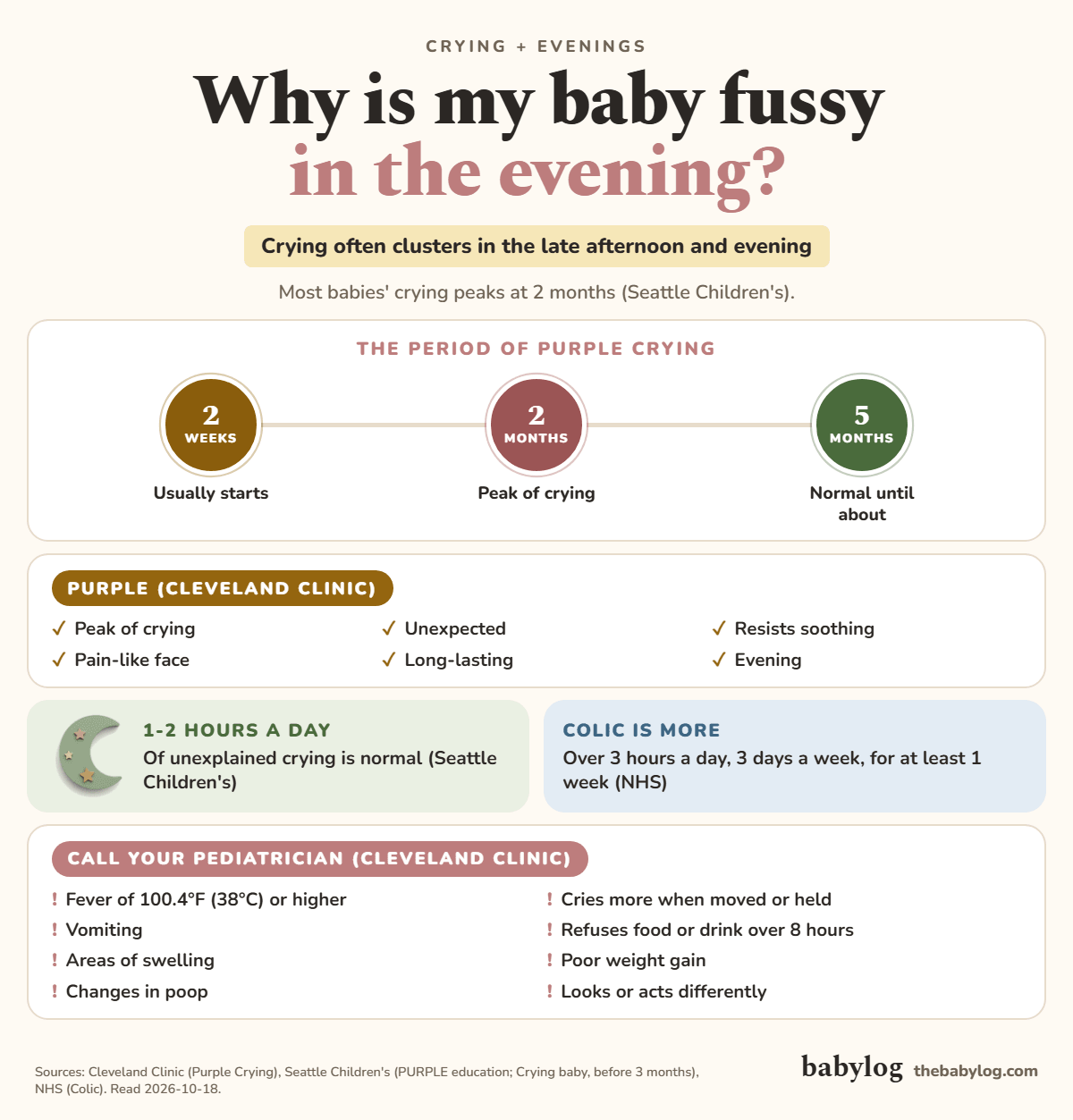
Crying that clusters in the late afternoon and evening is a normal, common pattern pediatricians call the Evening letter of the Period of PURPLE Crying, per Cleveland Clinic and Seattle Children's. It usually begins around 2 weeks old, intensifies week by week to a peak around 2 months, and eases within the first 5 months; soothing often does not stop it, and that is itself part of the normal pattern, not a sign something is wrong. This is different from colic, which the NHS defines as crying more than 3 hours a day, 3 or more days a week, for 3 or more weeks in an otherwise healthy baby; colic is a narrower diagnosis that most fussy-evening babies do not meet. Holding your baby close, gentle motion, white noise and taking turns with another adult help with either pattern. Get care now for a fever in a baby under 12 weeks old, a weak or high-pitched cry, nonstop crying beyond 2 hours, or refusing to drink for more than 8 hours; call your pediatrician for poor weight gain.
By the babylog team. Last updated November 18, 2026.
- Most common
- Late afternoon and evening
- Usually starts
- Around 2 weeks old
- Peaks around
- 2 months old
- Eases within
- The first 5 months

On this page8 sections
Healthy babies cry a lot in their first 5 months, and the crying usually clusters in the late afternoon and evening.[1][2] Seattle Children's says normal crying adds up to about 1 to 2 hours of unexplained crying a day, while its Period of PURPLE Crying materials note that some babies cry 1 to 2 hours a day and others up to 6.[2][4] Pediatricians have a name for the evening stretch: the Evening letter in the Period of PURPLE Crying, a normal pattern nearly every young baby goes through to some degree.[1][2] It usually begins around 2 weeks of age, builds week by week to a peak near 2 months, and fades within the first 5 months.[2] It is different from colic, a stricter, less common diagnosis covered in full in colic in babies.[3]
The Period of PURPLE Crying#
PURPLE is a way of describing a normal crying pattern, not a diagnosis. The program was developed by the National Center on Shaken Baby Syndrome, and the word "period" is deliberate: it means the crying has a beginning and an end.[2] Each letter names one feature that can leave a parent sure something is wrong when nothing is.
| Letter | What it means | What you see |
|---|---|---|
| P | Peak of crying | Crying rises each week, peaking in month 2, then decreasing in months 3 to 5[2] |
| U | Unexpected | Crying starts and stops with no clear reason[2] |
| R | Resists soothing | Crying may continue no matter what you try[2] |
| P | Pain-like face | Your baby may look like they are hurting even when they are not[2] |
| L | Long-lasting | Crying can last up to 5 hours a day or longer[2] |
| E | Evening | Crying often increases in the late afternoon and evening[1][2] |
How this is different from colic#
Both patterns can resist soothing, and neither means you are doing something wrong.[2][3] The difference is how much, how often, and for how long.
| Item | Evening fussiness (PURPLE) | Colic |
|---|---|---|
| How much crying | Often 1 to 2 hours a day of unexplained crying, more on some days[2][4] | More than 3 hours a day[3][4] |
| How often | Most babies, to some degree[1][2] | 3 days a week for at least 1 week, per the NHS[3] |
| When it starts | Around 2 weeks[2] | Can start when a baby is a few weeks old, per the NHS; before 2 weeks, per Seattle Children's[3][4] |
| When it peaks | Around 2 months[2] | 4 to 6 weeks, per Seattle Children's[4] |
| When it ends | Within the first 5 months[2] | Usually by 3 to 4 months[3][4] |
| Timing in the day | Clusters in the late afternoon and evening[1][2] | Can happen any time, though the NHS says it is often worse in the afternoon and evening[3] |
If your baby's crying meets colic's stricter rule of threes, more than 3 hours a day, 3 or more days a week, for 3 or more weeks, the full timeline, causes and when-to-call guidance live in colic in babies; that post is the place for the rule of threes itself, not this one.[3]
Check the ordinary causes first#
The sources do not offer a single explanation for why crying bunches up in the evening, and the Seattle Children's PURPLE page gives no percentage for it.[2] What they do offer is a list of ordinary causes to rule out before you decide the cause is the pattern itself. Seattle Children's names hunger as the most common cause of unexplained crying, with crying that usually stops when feeding starts, and the NHS lists hunger, a dirty diaper, wind, reflux and constipation as the things to rule out first.[3][4]
Tiredness is the one that most often lines up with the evening. Seattle Children's says that if it has been over 2 hours since your baby's last nap, sleepiness is a likely cause, and that overtiredness is prevented by helping your baby sleep before the fussing starts, which it puts at typically after about 2 hours awake.[4] It also suggests gently waking your baby to feed or play after a nap of 2 hours or more, so that long daytime naps do not push the fussy stretch later.[4]
Feeding matters too, in both directions. Cluster feeding in the evening is common at the same ages this pattern peaks, so ruling out hunger first is worth doing; see cluster feeding, how long it lasts. At the same time, Seattle Children's says not to feed every time your baby cries, because overfeeding can cause a bloated stomach, and to let your baby signal when full, for example by turning their head away.[4]
Before you decide it is evening fussiness
Needs
Comfort
- Wind or a stuck burp. See why is my baby so gassy and how to burp a baby.[3]
- Spit-up that looks like more than a little milk. See baby spitting up vs vomiting.[3]
Then look at the pattern
- Does it cluster in the late afternoon and evening, and ease within the first 5 months?[2]
- Does it stay under 3 hours a day, or does it match the rule of threes in colic in babies?[3]
What helps#
Soothing does not always stop this kind of crying, and the PURPLE materials say outright that it may not work every time, which is expected rather than a sign you are failing at it.[2] The sources agree on a short list of things to try:
- Close contact. Hold your baby close, with skin-to-skin contact; walk and sing to your baby, or take a walk outside.[2]
- Motion. Rock in a chair or while standing, use a swing or vibrating chair, or go for a stroller ride indoors or out. Rapid tiny movements or vibration often help.[4] The NHS suggests rocking over your shoulder, in a Moses basket or cot, or pushing a pram.[3]
- Steady sound. Seattle Children's recommends a low-pitched, constant sound such as a fan or a vacuum, kept on while your baby is crying and not so loud that it harms their hearing. The NHS suggests gentle background noise such as a radio.[3][4]
- A bath, a pacifier or massage. A warm bath is on the lists from the PURPLE materials, the NHS and Seattle Children's, which also lists a pacifier and massage.[2][3][4]
- Swaddling. Seattle Children's describes the burrito wrap, and cautions not to cover the head, not to overheat your baby, and to stop swaddling when rolling over starts. See how to swaddle a baby.[4]
- Upright feeds and winding. The NHS suggests holding your baby upright during feeds to reduce swallowed air, and winding after.[3]
With effective soothing, Seattle Children's says crying should drop to about 1 hour a day.[4] The NHS does not recommend anti-colic drops, herbal remedies or probiotic supplements, because there is no evidence they help.[3] For the full soothing checklist, see how to soothe a crying baby.
Do
- Expect more fussing in the late afternoon and evening; it is common, not a sign of a problem.[1][2]
- Rule out hunger, a wet or dirty diaper, and tiredness before assuming it is just evening fussiness.[3][4]
- Take turns with another adult when you can, and put your baby down safely and step away if you need a break.[2]
Don't
- Don't assume soothing failing means something is wrong; resisting soothing is part of the normal PURPLE pattern.[2]
- Don't feed at every cry; let your baby signal when full.[4]
- Don't confuse this with colic without checking the rule of threes in colic in babies.[3]
- Don't shake your baby, ever, even out of exhaustion.[2][4]
Myth
If nothing soothes my baby in the evening, I am doing something wrong.
Fact
Resisting soothing is one of the six features of the Period of PURPLE Crying, and the materials say soothing does not always work.[2]
When your patience runs out#
Hours of crying that you cannot fix wear on every adult in the house, and the PURPLE materials treat that as expected. Feeling angry is normal; what matters is how you respond. The common triggers they list are crying that exceeds expectations, feeling like a bad parent or a failure, and feeling tired or guilty.[2]
When you feel yourself reaching your limit, put your baby down in a safe spot, such as the crib, and walk away. Calm down for a few minutes, then check on your baby, and reach out to a trusted family member or friend for support.[2][4] Never shake your baby: shaking can cause the brain to bounce inside the skull, leading to severe bleeding and swelling, and it can cause blindness, brain damage and death.[2] Seattle Children's says shaking can cause brain bleeding and severe brain damage within seconds.[4]
When to call#
Seattle Children's sorts crying into tiers, and the table of signs below follows them.[4] The NHS adds that a cry that is weak, high-pitched or unlike your baby's normal cry needs urgent help.[3]
Care at home
Call your pediatrician
- Your baby is not gaining weight, or seems hungry.[4]
- New crying that can be consoled but has no clear cause.[4]
- Crying that started after 1 month of age.[4]
- You are exhausted from the crying, or you are finding it hard to cope.[3][4]
- Colic is present and nothing seems to help, or the crying continues after 4 months of age.[3]
Get care now
- A fever in a baby under 12 weeks old. Do not give fever medicine before they are seen.[4]
- Your baby is under 1 month old and looks or acts abnormal in any way.[4]
- Vomiting, a bulging soft spot, or crying when touched, moved or held.[4]
- Nonstop crying beyond 2 hours, or crying you cannot console.[4]
- Refusing to drink, or drinking very little, for more than 8 hours.[4]
- A weak, high-pitched, or otherwise abnormal-sounding cry.[3]
- You fear that you or someone else might hurt or shake your baby.[4]
- Your baby is not moving or is very weak: call 911.[4]
Why a log helps#
Evening fussiness is easier to place once you can see it next to the rest of the day. A Babylog timeline lines up feeds and sleep across the day, with a note on each fussy stretch, so you can see whether the evening stretch follows a long wake window or a short nap, how it compares with the 1 to 2 hour range, and whether a predictable evening stretch stands out from a pattern that fits colic's rule of threes instead. The feeding intervals tool shows whether evening cluster feeding could be part of what looks like fussiness, and the wake window calculator shows the typical awake stretch for your baby's age, a check on whether overtiredness by evening is adding to it. If the crying is part of a pattern you want to describe to your pediatrician, the pediatrician visit checklist is a place to note how many hours a day it lasts.
Frequently asked#
Why is my baby so fussy every evening? Most babies cry more in the late afternoon and evening; pediatricians call this the Evening letter of the Period of PURPLE Crying, a normal pattern that usually starts around 2 weeks old, peaks near 2 months, and eases within the first 5 months.[1][2]
How much crying is normal? Seattle Children's says about 1 to 2 hours of unexplained crying a day is normal; the PURPLE materials say some healthy babies cry up to 6 hours a day.[2][4]
Is evening fussiness the same as colic? No. Colic is a stricter, less common pattern: crying more than 3 hours a day, 3 or more days a week, for 3 or more weeks. See colic in babies for the full definition and timeline.[3]
Why doesn't soothing work? Resisting soothing is one of the expected parts of the Period of PURPLE Crying, not a sign you are doing something wrong.[2]
When should I call about evening crying? Call right away for nonstop crying beyond 2 hours, a fever in a baby under 12 weeks old, vomiting, crying when touched or held, or refusing to drink for more than 8 hours, and get care now for a weak, high-pitched or abnormal cry. Call your pediatrician for poor weight gain or crying that started after 1 month of age.[3][4]
Every baby is different, so talk to your pediatrician if you have questions about your baby's crying. Last reviewed October 28, 2026 against the sources below.
References
- 1.The Period of PURPLE Crying. Cleveland Clinic (2023). my.clevelandclinic.org
- 2.Period of PURPLE Crying. Seattle Children's Hospital (2024). seattlechildrens.org
- 3.Colic. NHS (2022). nhs.uk
- 4.Crying Baby - Before 3 Months Old. Seattle Children's Hospital (2025). seattlechildrens.org
Free tools for this topic
Related reading
Colic in babies: symptoms, causes, and when to call
Colic is crying over 3 hours a day, 3 days a week, for 3 weeks in a healthy baby. It peaks near 6 weeks and usually ends by 3 to 4 months. When to call.
How to soothe a crying baby, and when it is colic
Check hunger, diaper, temperature and tiredness, then hold, swaddle, rock or try white noise. Colic is crying 3+ hours a day and usually ends by 3 to 4 months.
Cluster feeding: what it is, when it happens, and how long it lasts
Cluster feeding bunches feeds close together, sometimes every 30-60 minutes in the evening. Growth-spurt clusters last a few days. When to expect them and cope.
Why is my baby so gassy? Causes, relief tips, and when to call
Almost all babies are gassy in the first two months from swallowed air and a developing gut. Burping, bicycle legs and tummy time help; know when to call.