
Health · Gas
Why is my baby so gassy? Causes, relief tips, and when to call
Short answer
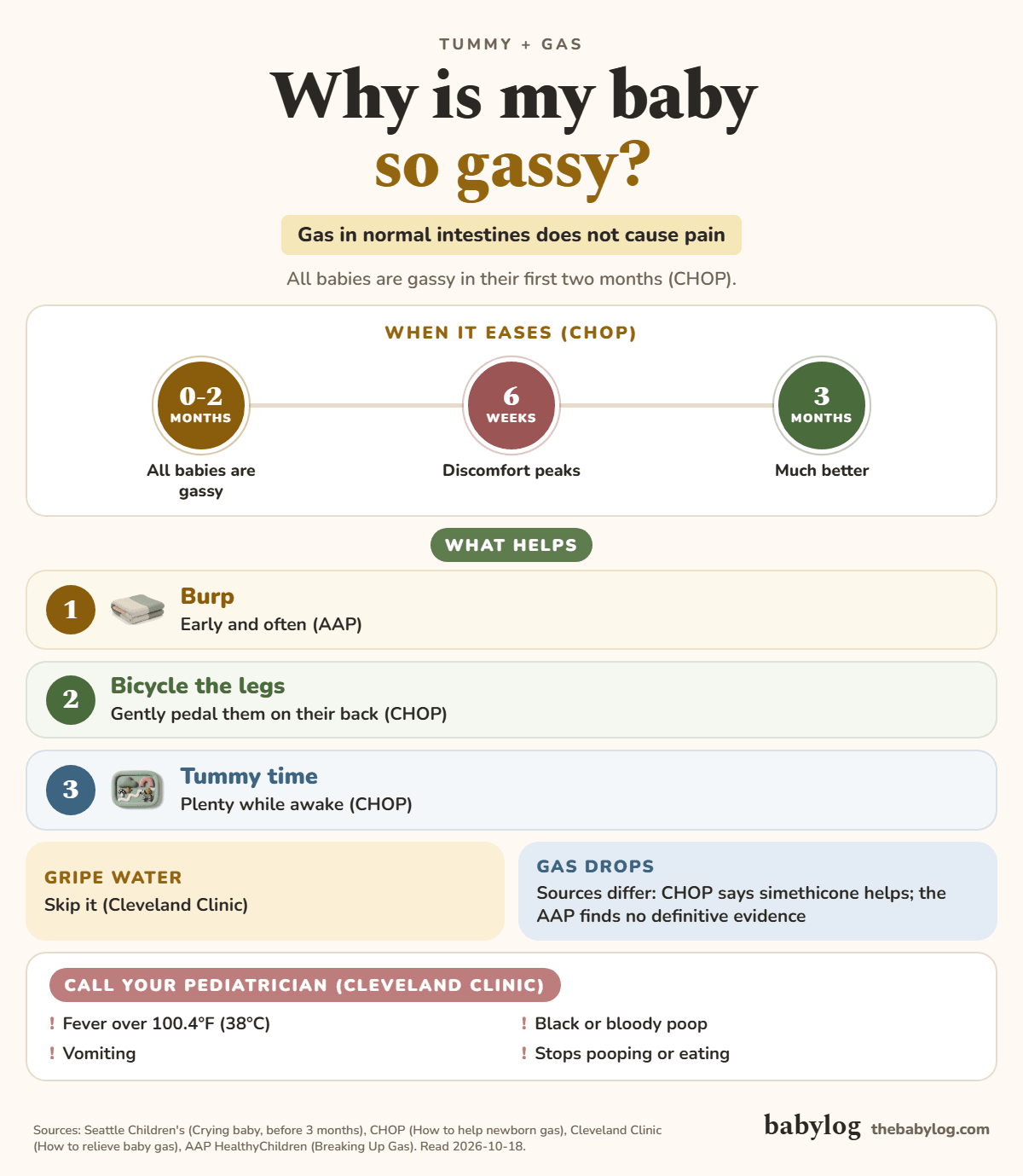
Gas passing through normal intestines does not cause pain, per Seattle Children's; all crying babies pass gas and make stomach noises, so gas alone is rarely what is actually hurting. Almost every baby is gassy in their first two months from swallowed air (burps) and normal gut bacteria digesting food (farts), per Children's Hospital of Philadelphia; the discomfort that can go with it typically peaks around six weeks and improves a lot by three months. The usual order of things to try: burp during and after feeds, bicycle the legs and try tummy time, and if that is not enough, ask about a formula or bottle and nipple change; the AAP finds no definitive evidence that simethicone gas drops help, though Children's Hospital of Philadelphia says you can use them as the label directs if they help your baby, and Cleveland Clinic advises skipping gripe water. Call your pediatrician if your baby is not pooping or eating normally, passes black or bloody stool, vomits, runs a fever above 100.4°F (38°C), is inconsolable, shows signs of an allergy, or gas is disrupting sleep, feeding or bowel movements.
By the babylog team. Last updated November 17, 2026.
- Gas itself
- Does not cause pain in normal intestines
- Nearly all babies
- Are gassy in their first 2 months
- Discomfort peaks
- Around 6 weeks old
- Usually eases by
- 3 months old

On this page9 sections
Here is the part most gas advice skips: gas passing through normal intestines does not cause pain or crying, and Seattle Children's calls blaming gas for a baby's crying a myth.[1] Every baby who cries makes stomach noises and passes gas, because healthy digestion is noisy.[1] What is real is that "all babies are gassy in their first two months of life," as Children's Hospital of Philadelphia puts it, and that the discomfort that sometimes comes with gas follows a predictable curve: it typically peaks around 6 weeks and improves greatly by 3 months.[2] This guide covers where the gas comes from, how to tell it from the more likely causes of crying, what helps (in order), where the sources disagree, and when to call.
Why babies get gassy#
Two things create gas. The first is air a baby swallows while feeding, crying or sucking on a pacifier, which comes back up as a burp.[2][3] The second is normal gut bacteria digesting leftover liquid in the intestines, which produces gas that comes out as a fart.[2] Diet, air bubbles that form in prepared formula, and a fast-flowing bottle or breast all add to it.[4]
A newborn is also new to all of this. Newborns have little experience with air and are not good at releasing gas, so they grunt, turn red, ball up, or cry while their bodies work it out.[2] Cleveland Clinic adds that some babies simply produce more gas than others, and some are still learning to coordinate their bodily functions.[3] Even the earliest farts in the first few days can be good news: Children's Hospital of Philadelphia says they may mean the gut is "waking up."[2]
Is it gas, or something else?#
This is the question worth answering before you reach for any remedy. Seattle Children's says normal crying adds up to about 1 to 2 hours of unexplained crying a day, spread across the day, and that hunger is the most common cause of crying, which usually stops when feeding starts.[1] The table lists what it names as more likely culprits than gas.
| More likely than gas | What to check | Source |
|---|---|---|
| Hunger | The most common cause; crying usually stops when feeding starts | Seattle Children's[1] |
| Sleepiness | If it has been over 2 hours since the last nap, sleepiness is a likely cause | Seattle Children's[1] |
| Overfeeding | Can cause a bloated stomach; let your baby signal when full, for example by turning their head away | Seattle Children's[1] |
| Temperature or clothing | Too hot, too cold, or tight clothing | Seattle Children's[1] |
| A soiled diaper | Stool irritates skin | Seattle Children's[1] |
| Caffeine | A breastfeeding parent's caffeine can increase crying and trouble sleeping | Seattle Children's[1] |
| Colic | The main cause of recurrent crying in the early months; see colic in babies | Seattle Children's[1] |
| Pain from somewhere else | Earache, mouth ulcers or a raw diaper rash; these babies are unhappy even when not crying | Seattle Children's[1] |
Spit-up is another thing that gets blamed. Seattle Children's says it happens in about half of babies, is normal, and does not cause crying or colic.[1] If it looks like more than a little milk coming back, baby spitting up vs vomiting and acid reflux in babies cover the difference.
Signs of a gassy baby#
A gassy baby is often extra fussy, with a scrunched-up face, more squirming than usual, and legs pulled up toward the chest; they may eat or sleep less than usual while it is happening.[3] These signs overlap with normal fussiness and with colic, so they are a reason to try gas relief steps, not on their own a reason to worry.[3] What makes gas look harmless is everything around it: your baby feeds well, gains weight adequately, and has soft, mushy stools that are green, yellow or brown, never bloody, white or black.[2]
| What you see | Fits ordinary gas | Call your pediatrician |
|---|---|---|
| Feeding | Feeds well | Stops eating |
| Poop | Soft, mushy stools in green, yellow or brown | Stops pooping, or stool that is black, bloody or white |
| Weight | Gains weight adequately | Not gaining weight as expected |
| Vomiting | Ordinary spit-up | Vomiting |
| Temperature | No fever | Fever above 100.4°F (38°C) |
| Settling | Fussy, but can be comforted | Unusually fussy and cannot be consoled |
The columns draw on Children's Hospital of Philadelphia for the harmless signs and on Cleveland Clinic and Seattle Children's for the reasons to call.[1][2][3]
What helps, in order#
The sources agree on the order: fix the feeding setup first, burp well, then use movement. Keep your expectations modest, because the AAP points out that breaking up gas is difficult, and no technique is guaranteed.[4]
1. Set up the feed to swallow less air#
Feed before your baby has cried for a long time from hunger, because hungry crying leads to gulping air.[2] Cleveland Clinic explains why: crying causes gulping breaths that add air, and so does rushed gulping during a feed.[3] If it has been at least 1 to 2 hours since the last feed and your baby is crying, try a feed.[2]
- Bottles. Cleveland Clinic suggests an angle-neck bottle with a slow-flow nipple, and says vented wands with internal straws and drop-in liners also help.[3] The AAP says to slow the flow by trial and error, and that vented, angled or collapsible bottles are designed to reduce swallowed air.[4] Children's Hospital of Philadelphia suggests trying different nipples and bottle shapes to cut down on gulping and sputtering.[2]
- Position. Feed as upright as possible.[2] Cleveland Clinic suggests a slight incline with your baby's head higher than their stomach, and tipping a non-angled bottle slightly upward so the nipple stays full and your baby sets the pace.[3]
- Formula prep. Mixing and shaking powdered formula creates more air bubbles.[4] Cleveland Clinic suggests stirring or swirling instead of shaking, then waiting a couple of minutes for bubbles to rise.[3] The AAP adds that concentrated or ready-to-feed formula, especially in the early days, skips the mixing step.[4]
- Breastfeeding. Hold your baby upright before switching breasts, and do not interrupt a feed to check for a burp. A change from vigorous sucking to comfort sucking is the signal that a burp is needed.[2]
Bottle setup check
The bottle
Position and pace
2. Burp during and after feeds#
The AAP says to burp during and after each feeding, though some babies dislike it.[4] Cleveland Clinic gives the rhythm: pause about halfway through and at the end of a feed, and for a gas-prone baby, burp after roughly every ounce.[3] Two positions work: over the shoulder, with your baby upright and their head above your shoulder, or the armrest hold, with your baby sitting sideways on your lap leaning slightly forward on your forearm. In both, pat or rub the midback, level with the upper abdomen; near the shoulders is too high to help.[3]
Not every baby burps, and Cleveland Clinic says not to force it.[3] If a burp seems stuck, Children's Hospital of Philadelphia suggests laying your baby down briefly and then sitting them upright to try again.[2] Seattle Children's adds a caution worth remembering: burping does not relieve crying, so if the crying continues after a good burp, go back through the table above.[1] For technique, see how to burp a baby.
3. Move the legs and give tummy time#
Lay your baby on their back and move their legs in a pedaling motion with your hands, a gentle gas-relief massage.[2][4] Cleveland Clinic says bending the knees toward the belly works too, and that the same motion may help with bowel movements, since some babies clench instead of pushing until they develop the coordination.[3]
Supervised tummy time may help push out trapped gas, and it strengthens the upper body.[4] If your baby is awake after a feed, Children's Hospital of Philadelphia suggests placing them on their belly.[2] This is awake, watched time only: every sleep still goes on the back, as covered in safe sleep guidelines for babies. For ages and routines, see tummy time by age.
Gas drops, gripe water and probiotics: where the sources disagree#
Gas products are where the advice stops lining up, so the table keeps each source's own words apart instead of blending them into one rule.
| Remedy | What the sources say | Source |
|---|---|---|
| Simethicone drops | The AAP could not find definitive evidence these drops are worth the effort and cost, says studies suggest they do not help colic, and says pediatricians increasingly recommend against them; if you try them, there is usually no harm, but ask your pediatrician first | AAP[4] |
| Simethicone drops | If FDA-approved drops help, use them as the label directs; if they do not help, stop | Children's Hospital of Philadelphia[2] |
| Simethicone drops | Over the counter and FDA-approved for infant gas; effectiveness varies, and they are suggested roughly 4 times a day as a preventive measure, since they are less likely to help once gas has built up | Cleveland Clinic[3] |
| Gripe water | Skip it: it is an herbal remedy the FDA does not regulate as a medication, and its safety and effectiveness have not been well researched | Cleveland Clinic[3] |
| Probiotics | Little data for infant gas; they have not been shown to affect gas, though they may shorten acute diarrhea and are considered mostly harmless in healthy infants | Children's Hospital of Philadelphia[2] |
| Heartburn medicine | Does not help crying babies and has side effects | Seattle Children's[1] |
Ask your pediatrician before giving any of them, as you would with any medication.[3][4]
Formula changes and a breastfeeding parent's diet#
If your baby is bottle-fed, a formula change is the next lever, and the sources urge a slow, one-step-at-a-time approach. Children's Hospital of Philadelphia suggests trying a change for one week at a time and returning to the original formula if the gas does not change.[2] Cleveland Clinic notes that a "sensitive" formula with lower lactose or partially hydrolyzed lactose may help straightforward gas, but these are still milk-based, so they are not for milk allergy or intolerance.[3] The AAP says to discuss any change with your pediatrician first.[4] More on the practical side is in switching baby formula.
If you are breastfeeding, treat your own diet as nutrition, not a restriction. Children's Hospital of Philadelphia says there is no absolute link between specific foods and infant gas and warns against cutting out many foods, because breastfeeding parents need varied nutrition.[2] Cleveland Clinic says research has not conclusively linked a parent's diet to baby gas, and that most breastfeeding parents are not advised to follow restrictive diets.[3] The AAP says foods that clearly distress your baby may be worth noticing, but identifying them is often difficult, and a parent's diet should not become so limited that it suffers.[4]
Myth
A baby who cries a lot must have trapped gas that needs to be broken up.
Fact
Gas passing through normal intestines does not cause pain or crying, and burping does not relieve crying.[1]
Do
Don't
- Don't expect simethicone drops to reliably help; the AAP finds no definitive evidence for them and says studies suggest they do not help colic, though Children's Hospital of Philadelphia says you can use them as the label directs if they help your baby.[2][4]
- Don't reach for gripe water; Cleveland Clinic advises skipping it because its safety and effectiveness have not been well researched.[3]
- Don't cut many foods from your own diet on a guess if you are breastfeeding.[2][3]
When to call#
Cleveland Clinic says gas itself is not a concern, though a gassy baby is often uncomfortable.[3] What matters is the company it keeps, and Cleveland Clinic says to contact a healthcare provider right away for the signs listed below.[3]
Care at home
Call your pediatrician
- Your baby stops pooping or eating.[3]
- Black or bloody stool. See baby poop color chart for what is normal versus a reason to call.[3]
- Vomiting.[3]
- A fever above 100.4°F (38°C).[3]
- Your baby is unusually fussy and cannot be consoled.[3]
- Gas interferes with bowel movements, sleep or feeding.[3]
- Your baby refuses to drink, or drinks very little, for more than 8 hours.[1]
Why a log helps#
Gas is easiest to sort from other causes once you can see the pattern: whether fussing clusters right after feeds, how much a bottle-fed baby is taking, and whether sleep and pooping look normal in between. A Babylog timeline puts feeds, sleep and diapers on one day, with a note wherever the fussing happened, so a change in the bottle, the nipple or the formula shows up against how your baby settled afterward. The feeding intervals tool shows the typical spacing for your baby's age, and the bottle volume tool helps spot overfeeding, which Seattle Children's lists as a cause of a bloated stomach.[1]
Frequently asked#
Is gas causing my baby's crying? Not by itself. Gas passing through normal intestines does not cause pain or crying, and every crying baby passes gas, so it is usually a normal part of digestion rather than the cause of the crying.[1]
When is baby gas at its worst? It is most common in the first four months, with discomfort that typically peaks around 6 weeks and eases a lot by 3 months.[2][3]
Do gas drops work? The AAP finds no definitive evidence that simethicone drops help, and studies suggest they do not help colic. Children's Hospital of Philadelphia says that if FDA-approved simethicone drops help your baby, you can use them as the label specifies. Cleveland Clinic advises skipping gripe water, since its safety and effectiveness have not been well researched.[2][3][4]
Should I change my formula or my diet? Ask your pediatrician first. For formula, Children's Hospital of Philadelphia suggests trying a change one week at a time and returning to the original if gas does not change; for a breastfeeding parent, avoid cutting out many foods.[2][4]
When should I call about gas? Call if your baby stops pooping or eating, has black or bloody stool, is vomiting, runs a fever above 100.4°F (38°C), seems inconsolable, shows allergy signs, or gas is disrupting sleep, feeding or bowel movements.[3]
Every baby is different, so talk to your pediatrician if you have questions about your baby's gas or feeding. Last reviewed October 28, 2026 against the sources below.
References
- 1.Crying Baby - Before 3 Months Old. Seattle Children's Hospital (2025). seattlechildrens.org
- 2.How to Help a Newborn with Gas. Children's Hospital of Philadelphia (2024). chop.edu
- 3.Gassy Baby? Try These 9 Gas Relief Tips. Cleveland Clinic (2024). health.clevelandclinic.org
- 4.Gas Relief for Babies. American Academy of Pediatrics (HealthyChildren.org) (2025). healthychildren.org
Free tools for this topic
Related reading
How to burp a baby: when, how long, and what to do if no burp comes
Burp a bottle-fed baby every 2 to 3 oz and a breastfed baby between breasts. See the three holds, timing by feed type, and spit-up tips.
Baby spitting up vs vomiting: how to tell, dehydration signs and when to call
Spit-up is an easy flow of milk, often with a burp; vomiting is forceful. How to tell them apart, the signs of dehydration, and when to call your pediatrician.
Acid reflux in babies: GER vs GERD, and when to call
Most baby reflux (GER) is normal spit-up that starts at 2 to 3 weeks, peaks at 4 to 5 months and fades by 1 year. See GER vs GERD and when to call.
How to soothe a crying baby, and when it is colic
Check hunger, diaper, temperature and tiredness, then hold, swaddle, rock or try white noise. Colic is crying 3+ hours a day and usually ends by 3 to 4 months.


