Sleep · Newborn noises
Why does my baby grunt and squirm in their sleep? What's normal
Short answer
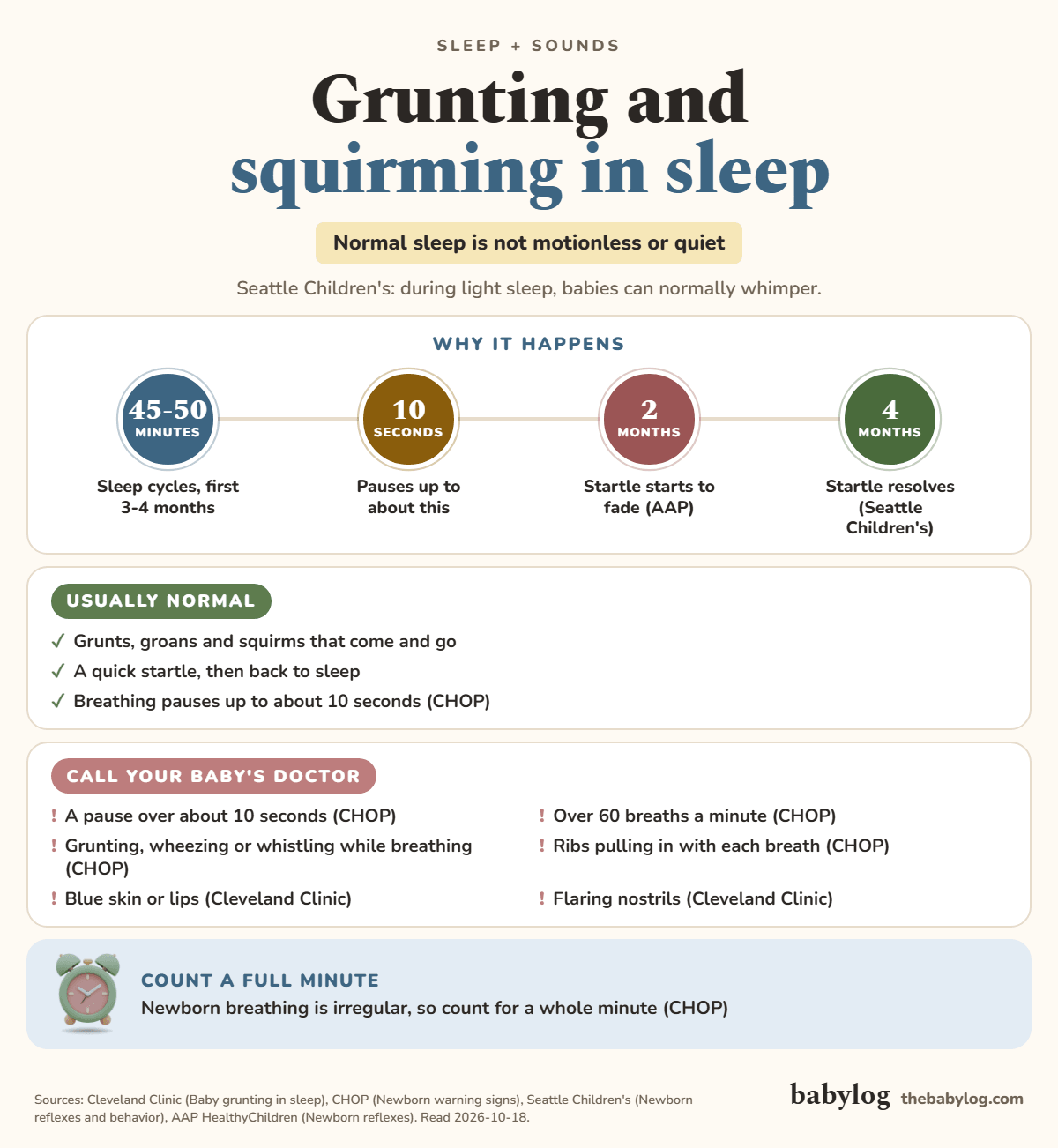
Grunting, groaning and squirming through sleep are normal for almost every baby, per Cleveland Clinic: newborns are still learning to breathe evenly (pauses up to about 10 seconds are typical), clear a stuffy nose, digest, or shift between sleep cycles roughly every 45 to 50 minutes. Children's Hospital of Philadelphia lists grunting while breathing as a newborn warning sign alongside a breathing rate above 60 breaths a minute, pauses longer than about 10 seconds, ribs pulling in with each breath, or blue coloring that does not go away, so the noise matters most when it comes with those signs. Most babies sleep more quietly by about 3 to 4 months.
By the babylog team. Last updated November 19, 2026.
- Breathing pauses
- Normal up to about 10 seconds
- Sleep-cycle shifts
- Come roughly every 45 to 50 minutes
- Moro (startle) reflex
- Fades between about 2 and 4 months
- Quieter sleep
- Most babies by 3 to 4 months
On this page7 sections
You are watching the monitor and your baby grunts, groans, and half-startles with both arms flying out, all without waking up. Most of the time this is normal: Cleveland Clinic says most noisy sleep is "nothing to worry about," and most babies sleep more quietly by about 3 to 4 months.[1] The numbers that separate ordinary noise from a reason to call are specific: a pause of up to about 10 seconds between breaths is typical, while a pause longer than about 10 seconds, a breathing rate above 60 breaths a minute, or blue coloring that does not go away is not.[1][2] This guide covers the five ordinary causes, why two respected sources seem to disagree about grunting, and what to do at 2 a.m. instead of scooping your baby up.
Five normal reasons a baby is noisy in sleep#
Cleveland Clinic lists five ordinary causes, and most babies have all five at once, at different points in the night.[1] Its list of normal sleep sounds is long: cooing, crying, gasping, grunting, gurgling, moaning, panting, snoring, snorting, squealing, wheezing and whimpering.[1]
- Still learning to breathe evenly. A newborn's breathing can be shallow and fast, and a baby can go several seconds, up to about 10, without a breath, then gasp and pick back up.[1]
- A stuffy nose. Newborns are obligate nose breathers, so congestion shows up loudly as snoring, snorting, wheezing or whistling.[1]
- Digestion. Working to burp, pass gas or have a bowel movement makes babies grunt and groan, with squirming, pushing, rumbling and bubbling sounds too.[1][3]
- Swallowing. Milk or formula that pools at the back of the throat after a feed causes gurgling, and babies often fall asleep before finishing a feed.[1]
- Shifting between sleep cycles. For the first 3 to 4 months, babies cycle between REM and non-REM sleep about every 45 to 50 minutes, and may cry or moan at the transitions until they develop self-soothing skills.[1]
| What you hear | Most likely reason | Source |
|---|---|---|
| Gurgling after a feed | Milk pooled at the back of the throat; Seattle Children's says it fades as babies learn to swallow more often | Cleveland Clinic, Seattle Children's[1][3] |
| Snorting, snoring, whistling | A stuffy nose, in a baby who can only breathe through the nose | Cleveland Clinic[1] |
| Grunting and groaning with squirming | Effort to burp, pass gas or poop; grunting while pushing out stool is normal | Cleveland Clinic, Seattle Children's[1][3] |
| Panting, fast shallow breaths | New breathing patterns; check the rate (under 60 a minute is normal) | Cleveland Clinic, Seattle Children's[1][3] |
| Moaning or crying about every 45 to 50 minutes | A shift between lighter and deeper sleep | Cleveland Clinic[1] |
| Arms flung open, brief cry | The Moro (startle) reflex | Seattle Children's, AAP[3][4] |
Breathing in newborn sleep is irregular#
Seattle Children's describes several breathing patterns that look worrying and are not. Periodic breathing is pauses of under 10 seconds, often followed by faster catch-up breaths; it is normal if the baby is comfortable, and it usually resolves by 1 month.[3] Transient rapid breathing, with progressively deeper breaths that normally slow within about a minute, is also normal, as are yawning and sighing, which open the lungs.[3] Seattle Children's also describes seesaw breathing, where the chest pulls in as the stomach expands because the rib cage is soft.[3]
Here the sources need careful reading, because Children's Hospital of Philadelphia lists ribs pulling inward with each breath, which it calls retractions, as a warning sign.[2] The two descriptions can look alike. Seattle Children's says to call the doctor for hard breathing, so when breathing looks like work instead of a gentle see-saw, call rather than judge it yourself.[3]
| What you see | Fits normal newborn sleep | Call your pediatrician |
|---|---|---|
| Pauses | Under 10 seconds, often followed by faster catch-up breaths | Longer than about 10 seconds |
| Rate | Under 60 breaths a minute, counted over a full minute | Above 60 breaths a minute |
| Chest | A gentle seesaw as the stomach expands | Ribs pulling inward with each breath, or heaving |
| Color | Normal skin color | Blue coloring that does not go away |
| Sounds | Occasional grunting, snorting or gurgling that comes and goes | Wheezing, grunting or whistling while breathing |
The rate matters because newborn breathing is normally irregular, so Children's Hospital of Philadelphia says to count breaths over a full minute.[2]
The Moro reflex: why babies startle mid-sleep#
The Moro, or startle, reflex is a full-body response: a baby's arms fling open, hands open, and the body briefly stiffens, triggered by a sudden noise, an abrupt movement or a shift in head position.[3][4] The AAP adds that the arms and legs extend and then the arms rapidly come together, and that your baby may cry loudly.[4] It can happen in sleep as easily as awake, which is why a sleeping baby sometimes throws both arms out and briefly cries.
The two sources on how long it lasts describe the same reflex from different ends of its timeline, so it is worth keeping both figures rather than picking one. The AAP says the Moro reflex is present from birth, usually peaks in the first month, and starts to disappear after about 2 months; Seattle Children's says it is frequent at birth and slowly resolves by 4 months.[3][4] Read together, that is a startle reflex that starts fading around 2 months and is usually mostly gone by about 4 months, not a fixed switch-off date.
- Periodic breathing pausesUsually resolves by 1 month[3]
- Moro reflexStarts to fade after about 2 months (AAP) and is gone by about 4 months (Seattle Children's)[3][4]
- 45 to 50 minute sleep cyclesThe cycle length for the first 3 to 4 months[1]
- Quieter sleepMost babies sleep more quietly by about 3 to 4 months[1]
Sleep twitches are a separate thing from the startle. Seattle Children's says sudden jerks or twitches of the arms, hands or legs that last a few seconds, may recur, and happen soon after falling asleep are normal at all ages.[3] It suggests suspecting a seizure if the jerking happens while your baby is awake or lasts more than 10 seconds.[3] The AAP's one call-worthy point about reflexes is symmetry: the Moro reflex should look the same on both sides of the body, so call if it looks different on one side or if your baby moves one side noticeably better than the other.[4]
When grunting is a warning sign, not normal noise#
This is the one distinction worth being precise about, because two respected sources describe grunting from opposite sides and it is easy to blur them.
Cleveland Clinic describes occasional, intermittent grunting during otherwise normal sleep, the kind that comes and goes with digestion or a sleep-cycle shift, as normal and not an emergency.[1] Children's Hospital of Philadelphia lists "wheezing, grunting, or whistling while breathing" as a newborn warning sign, in a list that also includes a breathing rate above 60 a minute, pauses longer than about 10 seconds, ribs pulling inward with each breath, and blue coloring that does not go away.[2] The two are not contradictory: they describe different babies. One is a baby whose noise comes and goes while they sleep and breathe comfortably; the other is a baby whose breathing itself is the problem.
Normal, care at home
- Occasional grunting, groaning or squirming that comes and goes, with your baby otherwise breathing and sleeping normally.[1][3]
- A brief startle (Moro reflex) with quick crying that settles back into sleep.[3][4]
- Breathing pauses of up to about 10 seconds between breaths.[1][2]
- Grunting while pushing out stool.[3]
Call your pediatrician
- A breathing rate above 60 breaths per minute, counted over a full minute.[2]
- Wheezing, grunting or whistling while breathing.[2]
- Ribs pulling inward with each breath.[2]
- Pauses between breaths longer than about 10 seconds.[2]
- A temperature above 100.4°F (38°C) or below 97.5°F (36.5°C), taken rectally, or a baby too sleepy to wake enough to feed.[2]
Children's Hospital of Philadelphia does not say which of its warning signs call for 911 and which for the doctor, only to call if you see signs that worry you.[2] The 911 list above is Cleveland Clinic's.[1]
What to do instead of picking your baby up#
The instinct when a baby grunts loudly is to scoop them up in case something is wrong. Most of the time that only interrupts a sleep-cycle shift your baby would have settled back through on their own. Cleveland Clinic's advice is to wait a few minutes first to see whether it is a sleep phase shift or gas, because babies often stay asleep through the noise.[1]
A 2 a.m. noise check
Watch for a minute
If the noise continues or your baby wakes
Cleveland Clinic also notes that experts recommend infants sleep in your bedroom but not in your bed.[1] Safe sleep guidelines cover the sleep-position and environment basics that matter regardless of how noisy a baby is.
Do
Time the nap, not the noise#
The hardest part of a grunting spell at 2 a.m. is not the noise, it is not knowing whether this is 20 minutes into a nap (early, likely a cycle shift) or 3 hours in (different story) without checking a clock half-asleep. A Babylog sleep timer answers that in one glance, so you are reacting to where your baby actually is in their sleep, not to how alarming the noise sounded. Our wake window calculator also helps separate "still settling into sleep" from "actually done napping" at any age. For the newborn stretch when noisy sleep is loudest, see newborn nap schedules; for why a baby wakes exactly at the cycle break instead of sleeping through it, why your baby is catnapping covers the same 45-to-50-minute rhythm from the other side.
Frequently asked#
Is it normal for my newborn to grunt through their whole nap? Intermittent grunting, on and off, is normal and usually tied to digestion or a sleep-cycle shift.[1][3] Grunting while breathing, together with a breathing rate above 60 a minute, ribs pulling in, pauses longer than about 10 seconds, or blue coloring, is different: call your pediatrician.[2]
Why does my baby fling their arms out and cry without waking up? That is almost always the Moro (startle) reflex, which can fire during sleep and is usually mostly gone by about 4 months.[3][4]
How long can my baby go without breathing before it's a problem? Pauses up to about 10 seconds are typical in a newborn. Longer than that is a reason to call.[1][2]
Is a fast breathing rate normal? Newborn breathing is irregular, so count over a full minute; under 60 breaths a minute is normal and above 60 is a reason to call.[2][3]
When does noisy sleep usually calm down? By about 3 to 4 months for most babies, per Cleveland Clinic.[1] The startle reflex fades over the same stretch.[3][4]
Every baby is different, so talk to your pediatrician if you have questions about your baby's breathing or sleep noises. Last reviewed October 28, 2026 against the sources below.
References
- 1.Baby Grunting in Their Sleep? Panting? Snoring? Here's What's Normal. Cleveland Clinic (Health Essentials) (2025). health.clevelandclinic.org
- 2.Newborn Warning Signs. Children's Hospital of Philadelphia (2026). chop.edu
- 3.Newborn Reflexes and Behavior. Seattle Children's Hospital (2025). seattlechildrens.org
- 4.Newborn Reflexes. HealthyChildren.org (American Academy of Pediatrics) (2022). healthychildren.org
Free tools for this topic
Related reading
Safe sleep for babies: the AAP 2022 rules in one checklist
Put your baby to sleep on their back, alone, on a firm flat surface with nothing else in the crib, in your room for 6 months. The AAP 2022 checklist.
Newborn nap schedules by week: what actually changes and when
No single newborn nap schedule fits every week. See how nap timing shifts from birth to 12 months and how to build a schedule from your own baby's pattern.
Why your baby is catnapping (and when it actually matters)
Catnapping is the 30 to 45 minute nap that ends right when you sit down. Here is what causes it, what to do, and why most cases resolve themselves.
How to swaddle a baby: the diamond fold, hip room, and safety rules
Swaddle a newborn safely: back sleeping, room for the hips, snug but not tight, and stop at signs of rolling. Includes the 6-step diamond fold.