
Feeding · Hunger cues
How do I know if my baby is hungry? Cues to watch before crying
Short answer
Crying is often a late sign of hunger, per the CDC. From birth to 5 months, the CDC lists four earlier cues: hands going to the mouth, the head turning toward the breast or bottle, lips puckering, smacking or licking, and clenched hands. Fullness looks like the reverse: the mouth closes, the head turns away and the hands relax. Cleveland Clinic puts breastfed newborns at about 8 to 12 feeds in 24 hours, and the AAP at 10 to 12.
By the babylog team. Last updated October 28, 2026.
- Earliest cues
- Hands to mouth, head-turning, lip movements
- Crying
- A late hunger cue, not the first one
- Breastfed newborns
- 8 to 12 feeds in 24 hours (10 to 12 per AAP)
- Full looks like
- Turning away, relaxed hands, closed mouth

On this page11 sections
Crying is often a late sign of hunger, so the cues worth learning are the quiet ones that come before it.[1] From birth to 5 months, the CDC lists four: hands going to the mouth, the head turning toward the breast or bottle, lips puckering, smacking or licking, and clenched hands.[1] Fullness looks like the reverse: the mouth closes, the head turns away, and the hands relax.[1] Feeding on the early cues matters because the AAP says crying can make settling and eating harder.[2]
- Treat crying as a late cue, not the first one
- 4 of 4 sources
- CDC, AAP, USDA WIC and Cleveland Clinic; WIC calls it a sign of distress
- Breastfed newborn to 2 months
- 8-12 feeds in 24 hours
- Cleveland Clinic; the AAP says 10 to 12 nursing sessions
- Bottle-fed babies by the end of the first month, about every 3 to 4 hours
- 3-4 oz per feed
- AAP
- The least expected from days 4 to 5 on, a check that feeding is enough
- 5-6 wet diapers a day
- AAP
Hunger and fullness at a glance#
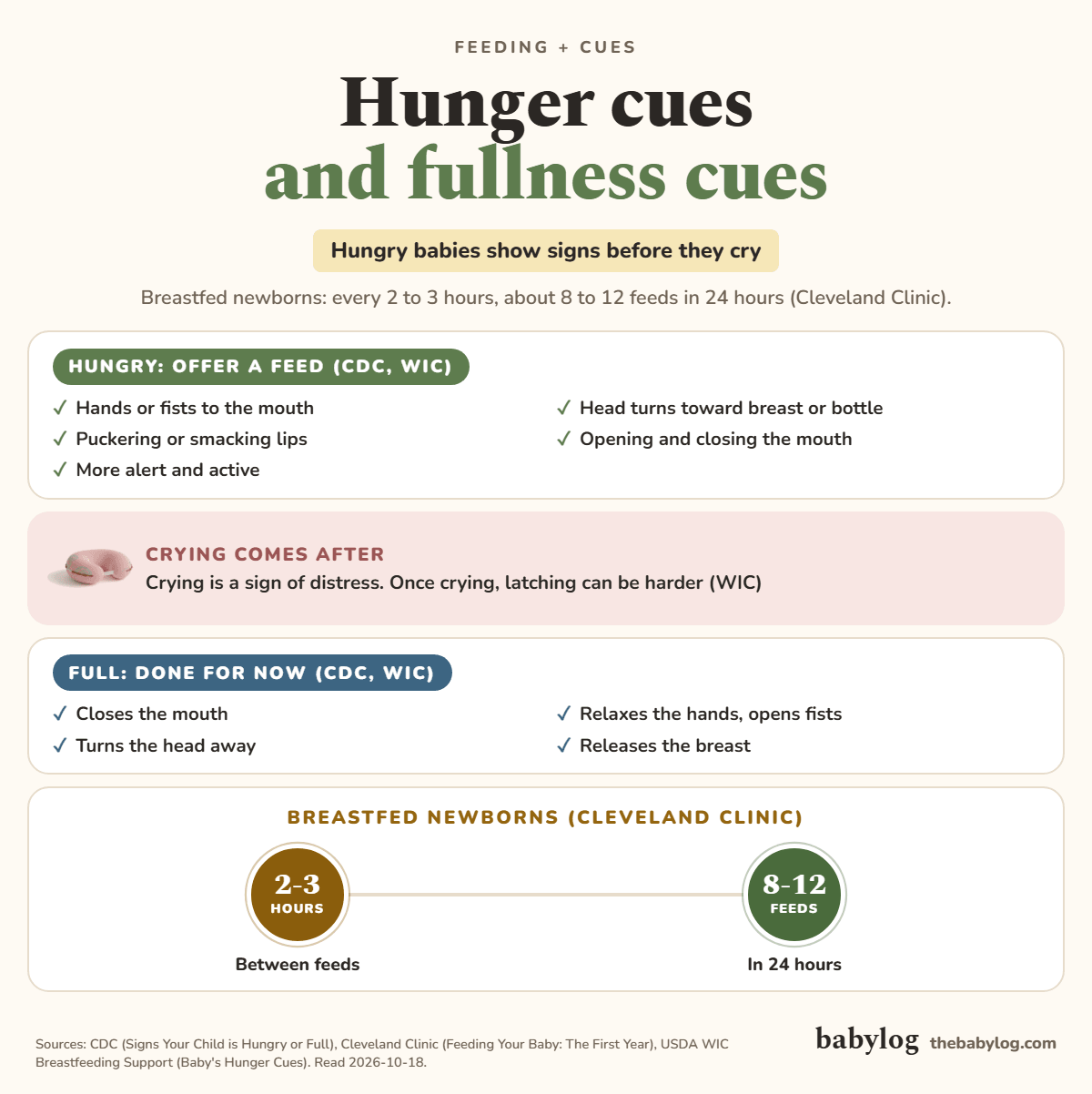
Birth to 5 months: the cues, side by side#
| Item | Hungry | Full |
|---|---|---|
| Hands | Go to the mouth, or clench | Relax |
| Head | Turns toward the breast or bottle | Turns away from the breast or bottle |
| Mouth | Lips pucker, smack or lick | Closes |
All of this is from the CDC.[1] Other sources add to the hunger side. Rooting, which means turning toward anything that brushes the cheek, shows up on the AAP list, and USDA WIC adds becoming more alert and active.[2][3] The table shows how far the four lists overlap.
| Cue | CDC | AAP | USDA WIC | Cleveland Clinic |
|---|---|---|---|---|
| Hands to mouth | Yes | Yes | Yes (fists to mouth) | Yes |
| Head turning or rooting | Yes | Yes (rooting) | Yes | Yes (head or jaw moving) |
| Lip smacking or licking | Yes | Yes | Yes | Yes |
| Opening the mouth | Not listed | Yes | Yes (opening and closing) | Yes |
| Sucking | Not listed | Yes (on everything around) | Yes (on hands) | Yes (on hands) |
| Clenched hands | Yes | Not listed | Not listed | Yes |
| Alert, active or excited | Not listed | Not listed | Yes | Yes (around food) |
| Fussiness | Not listed | Yes | Not listed | Yes |
| Crying | A late sign | A late sign | A sign of distress | A late cue |
"Not listed" means the page we read did not include it, not that the source disagrees. The first three rows are on all four lists, so those are the ones to start with.[1][2][3][4]
Why the early cues are worth catching#
The CDC says watching for early signs lets you feed "while they are still calm," and the AAP says crying is a late sign that can make settling and eating harder.[1][2] USDA WIC goes further: it says many parents think crying is the only sign of hunger, but "it's actually a sign of distress," and that hungry babies show signs before they cry.[3]
How fullness shows up#
The CDC's fullness cues from birth to 5 months are the closed mouth, the head turning away, and the hands relaxing.[1] USDA WIC describes the same thing at the breast: the baby releases or "falls off" the breast, turns away from the nipple, and relaxes their body with open fists.[3]
The CDC says to let your child decide how much they want, and that a child does not need to finish a bottle or all the food offered.[1] That matters most for bottles. The AAP says bottle-fed infants may not pull away or raise their hands to show they are full, and that overfed babies may have stomach pain, gas, spit-up or vomiting.[2] Our guide to signs your baby is full from a bottle covers that side in detail.
From 6 months: the cues change#
The CDC says children develop new hunger and fullness signs as they grow, and it lists a different set for 6 to 23 months.[1]
| Item | Hungry | Full |
|---|---|---|
| Body | Reaches for or points to food | Pushes food away |
| Mouth | Opens when offered a spoon or food | Closes when food is offered |
| Head | Gets excited when seeing food | Turns away from food |
| Signals | Hand motions or sounds that say still hungry | Hand motions or sounds that say full |
Cleveland Clinic says you can try solid foods around 6 months and lists readiness signs: sitting upright with little or no support, good head control, and opening the mouth when food comes toward them.[4] It puts typical solid meals at two to three a day at 6 to 8 months, and three to four meals plus one or two snacks from 9 months.[4]
Do
How often babies feed#
Cleveland Clinic says a breastfed baby will likely need feeding every two to three hours in the first two months, about 8 to 12 feedings in 24 hours, and a formula-fed baby a little less often, about 6 to 10 times.[4] The AAP gives different counts: about every 2 hours with 10 to 12 nursing sessions in 24 hours for breastfed newborns, and every 2 to 3 hours with 8 feedings in 24 hours as the minimum for bottle-fed ones.[2]
| Source | Breastfed newborn | Formula or bottle-fed newborn |
|---|---|---|
| Cleveland Clinic | Every 2 to 3 hours, about 8 to 12 in 24 hours | About 6 to 10 in 24 hours |
| AAP | About every 2 hours, 10 to 12 in 24 hours | Every 2 to 3 hours, 8 in 24 hours as the minimum |
Both sources give ranges, and the ranges overlap without matching. A breastfed baby who feeds 11 times in a day is inside both. One who feeds 9 times is inside Cleveland Clinic's range but below the AAP's, which is why diapers and growth are the better check than the count. The cues decide each feed.
Amounts per feed rise with age. Cleveland Clinic's figures for expressed breast milk:[4]
| Age | Per feed | Per 24 hours |
|---|---|---|
| First 24 hours | 2 to 10 mL | Not given |
| 24 to 48 hours | 5 to 15 mL | Not given |
| 72 hours | 1 oz | Not given |
| Day 7 | 1 to 2 oz | 10 to 20 oz |
| Weeks 2 and 3 | 2 to 3 oz | 15 to 25 oz |
| 1 to 6 months | 3 to 4 oz | 24 to 30 oz |
| 6 months and older | 3 to 4 oz | 18 oz or more |
For bottle feeding, the AAP's figures are about a half ounce in the first day or two, then 1 to 2 oz per feeding, at least 3 to 4 oz about every 3 to 4 hours by the end of the first month, and about 6 to 8 oz at each of 4 or 5 feedings by 6 months.[2] Cleveland Clinic says babies take about the same volume in 24 hours from 4 weeks to 6 months.[4] Our breast milk and formula amounts by age guide has the fuller breakdown, and cluster-feeding evenings are covered in how long cluster feeding lasts.
When your baby is too sleepy to show cues#
Babies born even a little early can be sleepy and may not take in enough in the early weeks, and the AAP says they should be followed closely to confirm they are growing along their growth curve.[2] If a baby has trouble gaining weight, the AAP says not to go too long between feedings, even if it means waking the baby.[2] Our guide on whether to wake a newborn to feed covers the first weeks.
Check that feeding is enough#
Cues tell you when to feed. Diapers and growth tell you whether it is working. The AAP says expect 2 to 3 wet diapers a day in the first few days, and at least 5 to 6 after days 4 to 5, with at least 4 stools by day 4.[2] Healthy growth on the chart at checkups suggests your baby is probably getting enough.[2]
Before you decide it is not hunger
Look first
- Are the hands going to the mouth or clenching?
- Are the lips puckering, smacking or licking?
- Is the head turning toward the breast or bottle?
Check the log
- How long since the last feed?
- Is today's count in line with the last few days?
- Were there at least 5 to 6 wet diapers yesterday, once past day 4 to 5?
When to call the pediatrician#
Usually fine
Call your pediatrician
- You are concerned your baby wants to eat all the time, even when full.[2]
- You think your baby is eating too little or too much.[4]
- Your baby's stool is very loose, watery, or full of mucus.[4]
- Your baby keeps refusing solid foods after 6 months despite many attempts, or seems to struggle with eating.[4]
- Your baby was born early or has a medical condition: the AAP says feedings scheduled by your pediatrician are best.[2]
How long since the last feed?#
Hunger cues answer "does my baby want to eat right now." They do not answer "how long has it actually been," which is where the second-guessing happens at 3 a.m. A Babylog feed log settles it in one glance. The feeding intervals tool shows whether feeds are running closer together or further apart than your baby's usual pattern, and the bottle volume tool shows whether the ounces taken are trending with age.
Frequently asked#
What is the very first sign my baby is hungry? Usually hands or fists moving to the mouth, which is on all four lists we read.[1][2][3][4]
My baby is crying. Does that mean they are very hungry? It means hunger has probably been building, since crying is a late sign.[1][2] It can also mean something else, so check the log and the cues.
How do I tell hunger from other fussiness? Hunger cues center on the mouth, head and hands.[1] Fussiness appears on two hunger lists but is not specific to hunger.[2][4] The AAP lists gas and stomach pain as signs a baby may have been overfed.[2]
How often should a newborn eat? About 8 to 12 times in 24 hours for breastfed babies per Cleveland Clinic, 10 to 12 per the AAP, and fewer for formula-fed babies.[2][4]
How do I know when to stop a feed? When fullness cues appear: a closed mouth, a head turned away, relaxed hands.[1] Any one alone is worth noticing, and several together mean the feed is done.
Every baby is different, so talk to your pediatrician if you have questions about your baby's feeding or growth. Last reviewed October 28, 2026 against the sources below.
References
- 1.Signs Your Child Is Hungry or Full. Centers for Disease Control and Prevention (CDC) (2026). cdc.gov
- 2.How Often and How Much Should Your Baby Eat?. American Academy of Pediatrics (HealthyChildren.org) (2024). healthychildren.org
- 3.Baby's Hunger Cues. USDA WIC Breastfeeding Support (2026). wicbreastfeeding.fna.usda.gov
- 4.Feeding Your Baby in the First Year. Cleveland Clinic (2023). my.clevelandclinic.org
Free tools for this topic
Related reading
Signs your baby is full from a bottle, plus the 2.5 oz per pound rule
Signs your baby is full from a bottle, the AAP 2.5 oz per pound a day rule, and how paced feeding helps prevent overfeeding at every age.
Cluster feeding: what it is, when it happens, and how long it lasts
Cluster feeding bunches feeds close together, sometimes every 30-60 minutes in the evening. Growth-spurt clusters last a few days. When to expect them and cope.
How much formula or breast milk by age: a feeding chart for the first 6 months
Babies take 1-2 oz per feed in week one, 3-4 oz by month one, and 6-8 oz at 4-5 feeds by 6 months, per the AAP. Chart by age for formula and breast milk.
Should you wake a newborn to feed? How long they can go between feeds
Yes, in the first couple of weeks: wake your newborn to feed every 3 to 4 hours until they show good weight gain. How long babies go between feeds, by age.


