Sleep · Swaddling
How to swaddle a baby: the diamond fold, hip room, and safety rules
Short answer
Lay your baby face-up with their head above the fold, wrap one side across their body and tuck it under, bring the bottom corner up and fold it at the chest so the hips and knees stay slightly bent and turned out, then wrap the other side across and tuck it in, leaving only the neck and head showing. Check that you can slip a hand between the blanket and your baby's chest, always place a swaddled baby on their back, watch for overheating, and stop swaddling at the first sign your baby is trying to roll.
By the babylog team. Last updated November 16, 2026.
- Fold steps
- 6
- Hip room check
- 2 to 3 fingers, chest to swaddle
- Always
- On the back, no more than one extra layer
- Stop swaddling
- At the first sign of rolling
On this page9 sections
A swaddle is safe when three things are true: your baby is on their back, their hips can bend up and out, and you stop at the first sign of rolling, which the AAP says can come as early as 2 months.[2] It is a comfort measure, not a safety measure. The AAP says swaddling doesn't reduce the risk of SIDS, and that some studies have shown an increased risk of SIDS and unintentional suffocation when swaddled babies sleep on their stomach or roll onto it.[2][3] Done right, it gives a newborn the snug, contained feeling of the womb without restricting their hips or breathing.
The diamond fold, step by step#
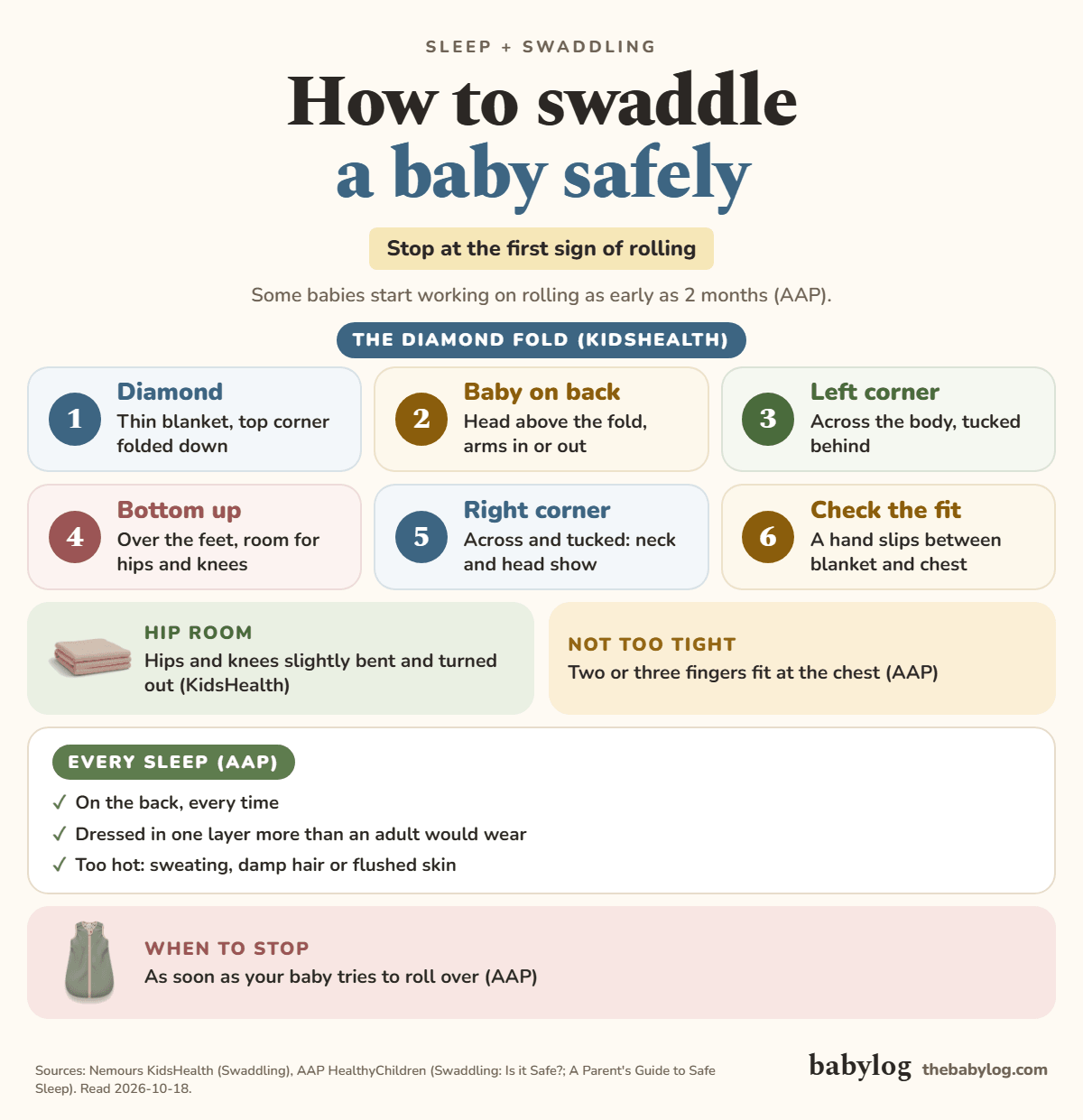
- Spread a thin blanket in a diamond, with one corner folded down to make a flat edge near the top.[1]
- Lay your baby face-up with their head above the folded edge. Arms at the sides, crossed or out are all fine; there's no evidence either way changes SIDS risk.[1][2]
- Wrap the left corner across your baby's body and tuck it snugly under their right side.[1]
- Bring the bottom corner up over your baby's feet and fold it down at the chest, keeping the blanket away from the face and leaving room for the hips and knees to stay slightly bent and turned out, not forced straight.[1]
- Wrap the right corner across and tuck it under your baby's left side, so only the neck and head are showing.[1]
- Check the fit. You should be able to slip a hand between the blanket and your baby's chest, but the wrap shouldn't be loose enough to come undone.[1]
What to wrap with#
Nemours suggests a thin baby blanket for the diamond fold.[1] The AAP prefers infant sleep clothing, such as layers of clothing, a wearable blanket or a sleep sack, over loose blankets and other coverings for keeping a baby warm.[2] A swaddle that comes unwrapped can end up over your baby's face, which is why the fit check in step 6 matters.[2]
| Option | What the sources say |
|---|---|
| Thin baby blanket, diamond fold | Nemours' method; check the fit with a hand at the chest[1] |
| Wearable blanket or sleep sack | The AAP prefers these to loose blankets for keeping a baby warm[2] |
| Weighted swaddle or blanket | Don't use; Nemours says it could harm breathing, and the AAP says not to use weighted swaddles, sleepers or blankets[1][2][3] |
| Loose blankets in the crib | None; the AAP says use a fitted sheet only, with nothing else in the crib[3] |
Get the hip room right#
Straightening and binding the legs together is the swaddling mistake that matters most for the hips. The AAP says studies have found that straightening and tightly wrapping a baby's legs can lead to hip dislocation or hip dysplasia, and that the Pediatric Orthopaedic Society of North America and the AAP Section on Orthopaedics promote "hip-healthy swaddling" that lets the legs bend up and out.[2] The AAP's test is at least two or three fingers between your baby's chest and the swaddle.[2] Nemours' hand-at-the-chest check in step 6 and the AAP's finger test both look for a wrap that is snug but not tight.
| Check | Hip-healthy | Risky |
|---|---|---|
| Legs | Free to bend up and out[2] | Straightened and tightly wrapped[2] |
| Hips and knees | Slightly bent and turned out[1] | Forced straight[1] |
| Chest | Two or three fingers fit between chest and swaddle[2] | Blanket pulled too tight[1] |
| Possible result | Hips can move freely[2] | Hip dislocation or hip dysplasia[1][2] |
Safety rules every swaddle should follow#
- Always place a swaddled baby on their back, never on their side or belly, and monitor so they don't roll over.[1][2]
- Never use a weighted swaddle or blanket.[1][3]
- Dress for no more than one layer more than you're wearing, the AAP's general rule; our reading is that the swaddle blanket counts as a layer.[3]
- Watch for overheating: remove the swaddle if your baby shows signs of being too warm.[1]
- Swaddling does not reduce the risk of SIDS, so it's an added comfort on top of, never a substitute for, back sleeping and a clear crib.[3]
The rest of the sleep space matters as much as the wrap. The AAP's safe sleep guide says to put your baby on their back for all naps and at night, use a fitted sheet only, and share a room with your baby for at least the first 6 months. It adds that soft objects and loose bedding can increase the risk of entrapment, suffocation or strangulation, that pacifiers help reduce SIDS risk even if the pacifier falls out after your baby is asleep, and that you shouldn't put a hat on your baby indoors once you're home from the hospital.[3]
Before you lay your baby down
The wrap
- Thin blanket, folded in a diamond, fit checked with a hand at the chest
- Two or three fingers fit between chest and swaddle
- Hips and knees slightly bent and turned out
The sleep space
- On their back, on a firm, flat surface with a fitted sheet only
- No loose blankets, no weighted products, no hat indoors
- Not sweating, flushed or breathing fast
Arms in or out#
Either is fine. The AAP says there is no evidence about SIDS risk related to arms swaddled in or out, and Nemours lists arms at the sides, crossed or left out as options.[1][2] So it comes down to what settles your baby. Whichever you pick, the back-sleeping, hip and overheating rules above still apply.
When to stop#
Stop swaddling as soon as your baby shows any signs of trying to roll over. Nemours gives turning onto their side as an example and says this is usually around 2 months, and the AAP says some babies start working on rolling as early as 2 months, though every baby is different.[1][2] The trigger is the sign, not the date.
- Swaddling, if you use itFrom birth until the first rolling signs
- Rolling attempts can beginAs early as about 2 months
Once you stop, the AAP's preferred alternative for warmth is a wearable blanket or sleep sack rather than a loose blanket.[2] For the full timing guidance and how to make the transition, see when to stop swaddling.
Do
What to use instead of extra blankets#
Overheating is easier to avoid when the swaddle itself is the only layer doing the work, rather than adding loose blankets on top. The what to dress your baby for sleep tool turns your room temperature into a layering suggestion, so you're not guessing whether the swaddle plus what's underneath adds up to too much.
Logging sleep while you're swaddling#
The early weeks of swaddled naps and night sleep are also when a pattern starts to show. Babylog logs each sleep with the time it started and ended, so you can see stretches lengthen as your baby grows, right up to when it's time to make the switch out of the swaddle. Safe sleep guidelines covers the rest of the crib setup, and how to dress your baby for sleep covers layering once the swaddle is gone.
Frequently asked#
Should my baby's arms be in or out of the swaddle? Either is fine. The AAP says there's no evidence either way changes SIDS risk, so it comes down to what settles your baby.[2]
How do I know if the swaddle is too tight? If you cannot slip a hand between the blanket and your baby's chest, or fit two or three fingers there, it is too tight, and the legs need room to bend up and out too.[1][2]
Does swaddling help with sleep? Swaddling can help some babies settle, but the AAP is clear that it doesn't reduce SIDS risk, so back sleeping and a clear crib still matter just as much.[3]
Is swaddling safe at all? It can be, when your baby is on their back, the hips have room and the wrap stays snug and in place. The AAP says some studies show increased risk of SIDS and suffocation when swaddled babies sleep on their stomach or roll onto it.[2]
Can I use a weighted swaddle? No. Nemours says it could harm your baby's breathing, and the AAP says not to use weighted swaddles, sleepers or blankets.[1][3]
When exactly should I stop swaddling? At the first sign your baby is trying to roll over, whenever that happens. That can start as early as 2 months, so see when to stop swaddling for the signs to watch for.[1][2]
Always follow the instructions your own pediatrician gave you for your baby. Last reviewed October 28, 2026 against the sources below.
References
- 1.Swaddling (reviewed January 2024). Nemours KidsHealth (2024). kidshealth.org
- 2.Swaddling: Is it Safe? (page date 7/15/2022). American Academy of Pediatrics (HealthyChildren.org) (2022). healthychildren.org
- 3.A Parent's Guide to Safe Sleep (last updated 9/11/2026). American Academy of Pediatrics (HealthyChildren.org) (2026). healthychildren.org
Free tools for this topic
Related reading
When to stop swaddling: the rolling rule, the 2-month guidance, and how to transition
Stop swaddling at the first sign your baby is trying to roll, the AAP says; some start as early as 2 months. Here is how to swaddle safely and switch.
Safe sleep for babies: the AAP 2022 rules in one checklist
Put your baby to sleep on their back, alone, on a firm flat surface with nothing else in the crib, in your room for 6 months. The AAP 2022 checklist.
How to dress your baby for sleep in winter: layers, room temperature and sleep sacks
Dress your baby in one more layer than you would wear, use a sleep sack instead of loose blankets, and keep the room at 16 to 20°C (61 to 68°F).
Why does my baby grunt and squirm in their sleep? What's normal
Grunting and squirming in sleep is normal for most babies as they learn to breathe evenly and shift sleep cycles. Here are the warning signs that mean a call.