
Feeding · Formula prep
How to make a bottle of formula, the safe way
Short answer
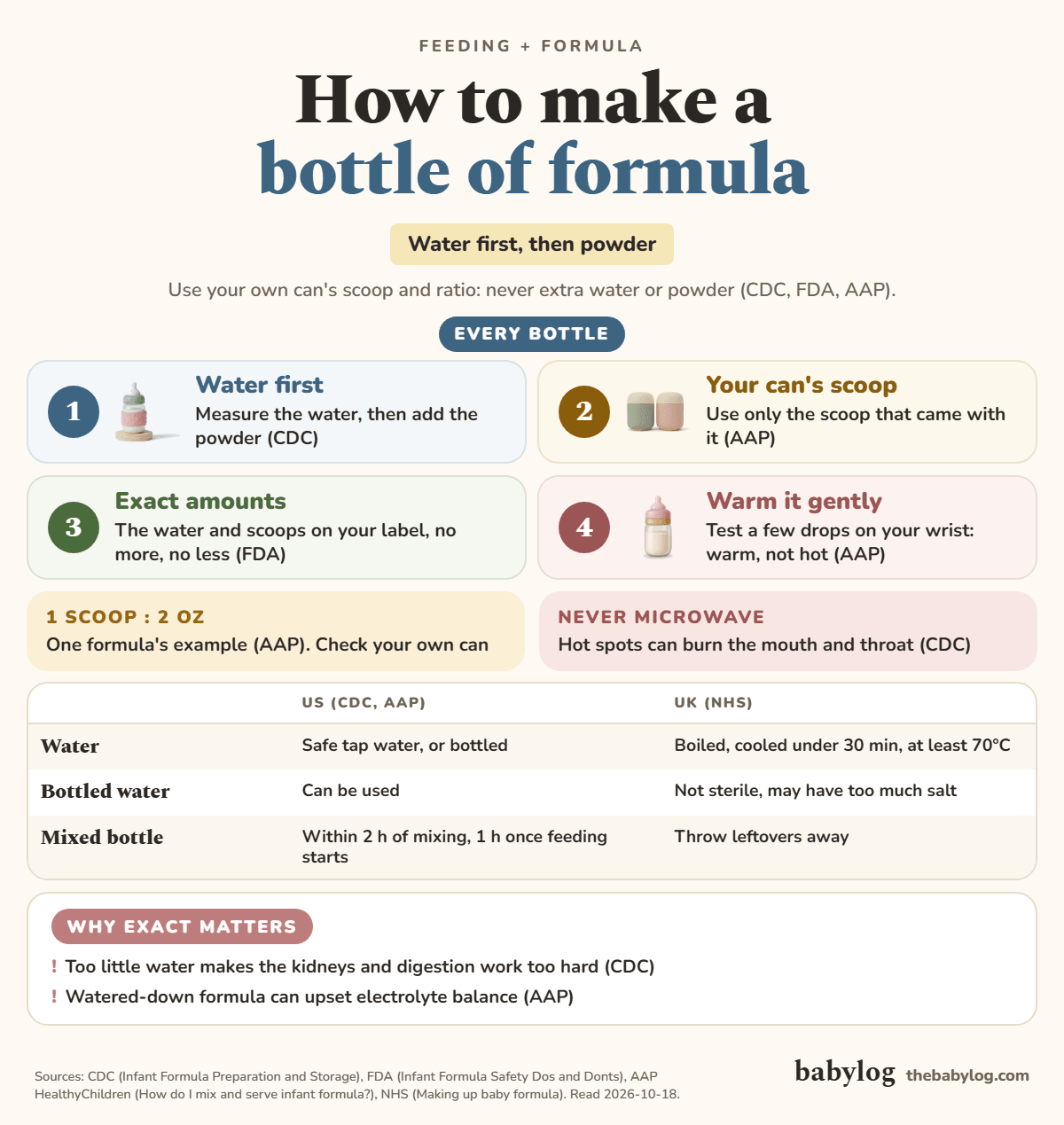
Measure the water first, then add the powder, using only the ratio and scoop that come with your own can. 1 level, unpacked scoop per 2 fl oz of water is the American Academy of Pediatrics' common example, not a rule every formula follows, so check your can. Never add extra water to stretch a container or extra powder to make it stronger: the AAP links watered-down formula to electrolyte problems and seizures, the CDC says too little water can make your baby's kidneys work too hard, and the FDA ties homemade formula to low calcium. In the US, the CDC says a mixed bottle is good for up to 2 hours before a feeding and 1 hour after your baby starts, or refrigerated for up to 24 hours; the UK's NHS requires water that is boiled and still hot when the powder goes in, and discards any leftover after a single feed with no grace window. Never microwave a bottle.
By the babylog team. Last updated November 12, 2026.
- Order
- Water first, then powder
- Your can's ratio
- Common example: 1 scoop per 2 fl oz
- Never
- Add extra water or powder
- Mixed bottle, US (CDC)
- 2 hrs before feeding, 1 hr after starting
On this page11 sections
Measure the water first, then add the powder, using only the scoop and ratio that come with your own container. The CDC says prepared formula should be used within 2 hours of mixing and within 1 hour of when your baby starts feeding, or put in the fridge right away and used within 24 hours.[1] Use the formula mixing calculator with the ratio printed on your own can, confirmed by you, not assumed from an example.
From can to bottle in six steps#
Every source agrees on the order: clean first, water next, powder last.
- Wash your hands and clean the space. The CDC says to wash your hands well, clean and sanitize the workspace, and start with bottles that are clean and sanitized.[1] The AAP says sterilizing bottles and nipples is not necessary for most healthy, full-term babies, especially if they go through a dishwasher, while the NHS tells UK parents to wash and sterilise them before every feed.[3][4]
- Pour the water in first. Use the amount of water listed in the container's instructions, and measure it before any powder goes in.[1]
- Add the powder with that container's own scoop. Fill the scoop loosely, then level it off with a clean, dry knife or the leveller supplied.[4] The AAP's example is 1 level, unpacked scoop per 2 fl oz of water, but scoop sizes differ by brand and even between formula types from the same brand, so never swap in a scoop from another can.[3]
- Close the bottle and mix. Shake or stir until the powder dissolves.[3][4]
- Check the temperature. Put a few drops on the inside of your wrist. It should feel warm or body temperature, not hot.[1][3][4]
- Throw out what is left after the feed. The CDC says formula mixed with your baby's saliva lets bacteria grow, so leftover formula never goes back in the fridge. Clean and sanitize the bottle before its next use.[1]
Water first, then your can's own ratio#
Formula comes in three forms, and only powder uses a scoop.[2][3]
Getting the ratio wrong matters in both directions. The CDC says too little water can make a baby's kidneys and digestive system work too hard and lead to dehydration, and too much means the formula may not meet their nutritional needs.[1] The AAP says watered-down formula can slow growth and development and can upset the balance of electrolytes, the salts and minerals the body needs, which can cause seizures.[3] The NHS adds that extra powder can leave a baby constipated or dehydrated, while too little powder may not give enough nourishment.[4] The FDA says not to make homemade formula at all, citing reports of hospitalized babies fed it who developed low calcium.[2]
That is also why the formula mixing calculator asks you to enter and confirm your can's ratio before it calculates anything, rather than assuming the AAP's example for every formula.
Which water to use#
The CDC says to use water from a safe source, filtered or unfiltered, and to call your local health department if you are not sure your tap water is safe.[1] The AAP says to use cold water from the faucet, because warm tap water may contain softener salt that can pull impurities from pipes, to test well water every year, and, if bacteria in the water is a concern where you live, to bring it to a rolling boil for 1 minute and cool it to room temperature first. Bottled water also works.[3]
| Question | United States (CDC, AAP) | United Kingdom (NHS) |
|---|---|---|
| Tap water | Usually fine if your local supply is safe[1][3] | Freshly boiled tap water, never water boiled before[4] |
| Water temperature | Follow the container; boil, wait about 5 minutes, then mix for the highest-risk babies[1] | At least 70°C (158°F) when the powder goes in, for every feed[4] |
| Bottled water | Fine to use[3] | Not usually recommended: not sterile, may contain too much sodium or sulphate[4] |
| Sterilizing | Clean and sanitize; the AAP says sterilizing is not needed for most healthy, full-term babies[1][3] | Wash and sterilise before each feed[4] |
The two countries start from the same fact: powdered formula is not sterile. The NHS says even sealed tins and packets can sometimes contain bacteria, and the CDC says powder can carry germs such as Cronobacter that need very hot water, around 158°F (70°C), to be killed.[1][4] The NHS applies the hot-water method to every feed. The CDC applies it to the babies at highest risk, described next.
Extra care for the youngest babies#
Cronobacter infections are rare, but the CDC says they can be deadly for infants, especially newborns. Babies younger than 2 months are the most likely to develop meningitis if infected, and babies with a weakened immune system are also at higher risk.[5] The CDC asks for extra steps for babies who are younger than 2 months, were born before 37 weeks, or have a weakened immune system: boil the water, wait about 5 minutes, mix the powder in, then let the bottle cool before feeding so you do not burn your baby's mouth.[1]
The FDA draws its line at 3 months instead, and tells parents of babies that young, born early or with a weakened immune system to ask their pediatrician whether extra steps are needed.[2] The two lines differ, so ask your pediatrician which one applies to your baby.
Before you mix
Clean
- Hands washed well
- Workspace cleaned and sanitized
- Bottle, nipple and ring clean (sterilised if you follow UK advice)
- Lid and scoop kept off the counter
Measure
- Water in first, to the amount the container's instructions give
- Only the scoop from this container, leveled off
- Water prepared the way your pediatrician advised for your baby's age
After mixing
- A few drops on the inside of your wrist: warm, not hot
- The time noted, so the 2-hour and 1-hour clocks are easy to follow
- Leftover formula thrown out after the feed
How long a mixed bottle can wait#
The CDC's rule runs on two clocks. Prepared formula can spoil at room temperature, so use it within 2 hours of preparation and within 1 hour from when feeding begins. If you will not start within 2 hours, put the bottle in the fridge right away and use it within 24 hours.[1]
- Start feeding byWithin 2 hours of mixing, at room temperature
- Or keep it in the fridgeRefrigerate right away if feeding will not start within 2 hours, then use within 24 hours
Once feeding starts, the second clock begins: 1 hour, then the bottle goes out.[1] The NHS is stricter about timing. It says bacteria multiply very fast at room temperature, and even in the fridge they can survive and multiply, more slowly, so it is best to make up feeds one at a time, as your baby needs them.[4]
To warm or not to warm#
Formula does not need to be warm, the CDC and the FDA both say.[1][2] The AAP leans the other way for the youngest babies: it is best to warm formula for babies under 6 months because they cannot yet regulate their body temperature well, and older babies often take room-temperature formula just fine.[3] If you do warm a bottle, hold it under running warm water, use a bottle warmer, or stand it in a container of warm water for 5 to 10 minutes, keeping water out of the bottle and off the nipple.[1][3] Then test a few drops on the inside of your wrist.
Never use a microwave. Microwaving heats unevenly and can create hot spots that burn your baby's mouth and throat.[1][2][3]
How much to make#
Mix one bottle at a time, sized to the feed, so little is left to throw out. The AAP says babies in the first week eat no more than about 1 to 2 ounces (30 to 60 mL) per feed, work up to 3 to 4 ounces (90 to 120 mL) by the end of the first month, and by 6 months take 6 to 8 ounces (180 to 240 mL) at each of 4 or 5 feeds in 24 hours.[6]
Formula per feed, by age
- First week1 to 2 oz30 to 60 mLNo more than about this per feed
- End of month 13 to 4 oz90 to 120 mLRoughly every 3 to 4 hours
- 6 months6 to 8 oz180 to 240 mL4 or 5 feeds in 24 hours
For a day-by-day picture, see how much formula or breast milk by age and signs your baby is full from a bottle.
Storing the container and the bottle#
Store unopened containers in a cool, dry place indoors, not in a vehicle, garage or outdoors. Once a container is open, keep the lid tightly closed in a cool, dry place and not in the refrigerator, and write the date on the lid: most formulas need to be used within 1 month of opening, so check the label. Never use formula after its Use By date.[1] The FDA adds that freezing formula is not recommended because its components can separate.[2]
Do
If a bottle comes out wrong#
A one-time mix-up
- If a single bottle came out wrong by accident, feed it as usual and mix the next one to your can's own directions; the formula mixing calculator does the scoop math. One bottle is not an emergency.[3]
Call your pediatrician right away
Get medical care as soon as possible
- A baby under 1 year old with a fever, poor feeding, excessive crying or very low energy, or any seizure; the CDC says these can be signs of Cronobacter infection and to take a baby with these symptoms to a medical provider as soon as possible.[5]
Get it right every time#
Your own can's label is the final word on ratio; the formula mixing calculator turns a water amount and your confirmed ratio into scoops, or a bottle size into concentrate and water for liquid formula, without ever suggesting a part scoop or a stretched batch. Babylog also logs every feed, so you can see exactly how much your baby actually drinks next to how you mixed it. For bottle hygiene between feeds, see how to clean baby bottles; for switching formulas, see switching baby formula.
Frequently asked#
Can I make bottles ahead for the night? The CDC allows a bottle that goes into the fridge right away to be used within 24 hours.[1] The NHS says it is best to make feeds up one at a time, as your baby needs them.[4] Ask your pediatrician if your baby is very young or was born early.
Is 1 scoop per 2 fl oz of water the right ratio for every formula? No. It's the AAP's commonly quoted example, not a universal rule - scoop sizes and water ratios differ by brand and formula type. Use the formula mixing calculator with the ratio printed on your own can.[3]
Your own can's label governs the ratio; this only covers the order, the water, and how long a mixed bottle can wait. Talk with your pediatrician about any question on your baby's feeding. Last reviewed October 28, 2026 against the sources below.
References
- 1.Infant Formula Preparation and Storage (last reviewed 2026-05-14). Centers for Disease Control and Prevention (2026). cdc.gov
- 2.Infant Formula Safety: Do's and Don'ts. U.S. Food and Drug Administration (2023). fda.gov
- 3.How do I mix and serve infant formula for my baby? (updated 2018-03-23). American Academy of Pediatrics (HealthyChildren.org) (2018). healthychildren.org
- 4.Making up baby formula (last reviewed 2023-08-31). NHS (2023). nhs.uk
- 5.About Cronobacter (page carries no date; read 2026-10-28). Centers for Disease Control and Prevention (2026). cdc.gov
- 6.Amount and Schedule of Baby Formula Feedings (last updated 2022-05-16). American Academy of Pediatrics (HealthyChildren.org) (2022). healthychildren.org
Free tools for this topic
Related reading
How to clean baby bottles, and when you really need to sterilize
How to clean baby bottles: wash after every feeding in a basin, not the sink, and air-dry. Sanitize daily under 2 months. Where CDC and NHS advice differ.
Switching baby formula: when a new brand is fine and when to ask first
Most babies do fine switching formula brands of the same type, the FDA says. Changing type is a pediatrician call. Here is how to switch.
How much formula or breast milk by age: a feeding chart for the first 6 months
Babies take 1-2 oz per feed in week one, 3-4 oz by month one, and 6-8 oz at 4-5 feeds by 6 months, per the AAP. Chart by age for formula and breast milk.
Signs your baby is full from a bottle, plus the 2.5 oz per pound rule
Signs your baby is full from a bottle, the AAP 2.5 oz per pound a day rule, and how paced feeding helps prevent overfeeding at every age.


